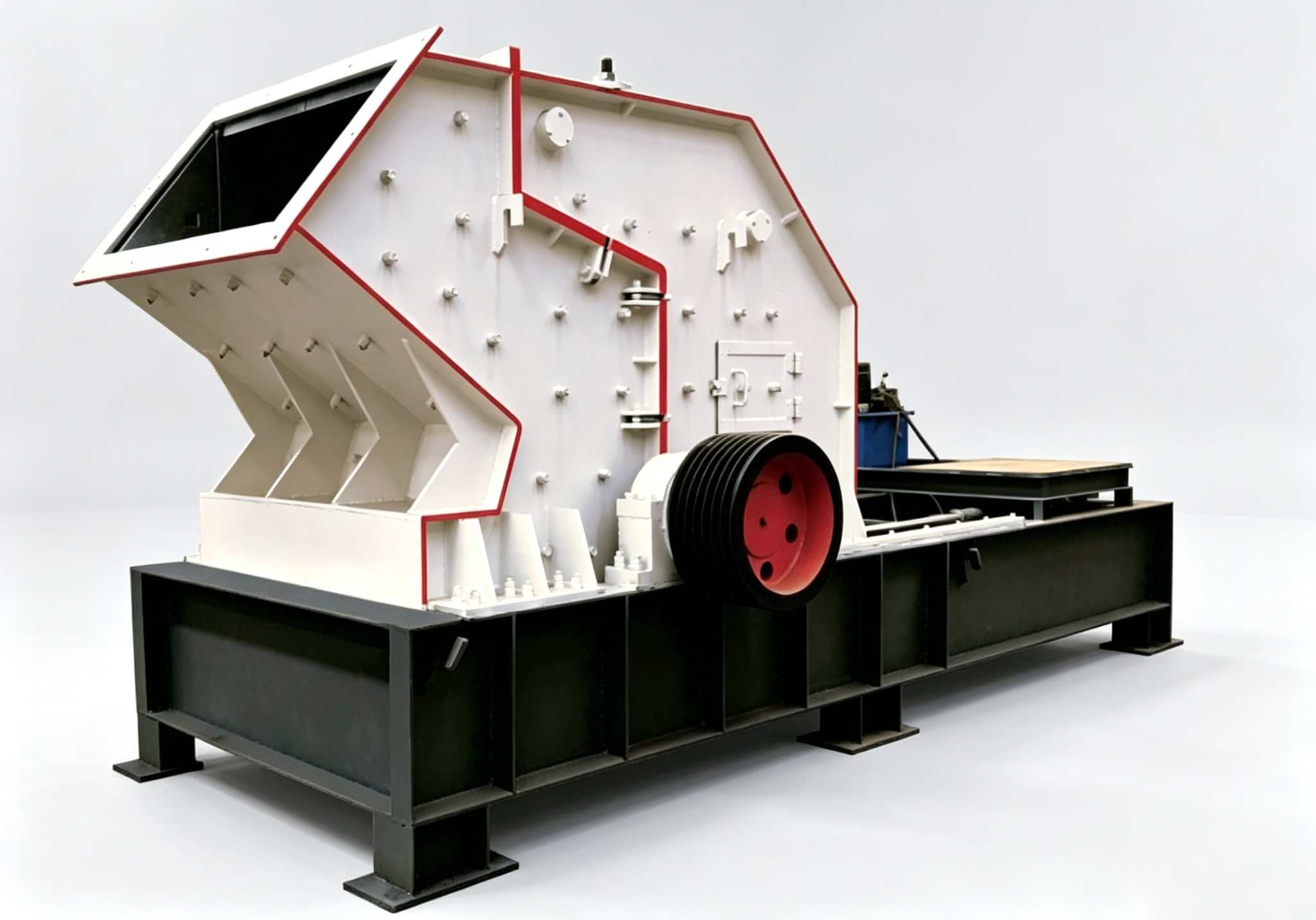
Hydraulic Box Sand Maker

Hydraulic Opening Series · Feed ≤200mm · Discharge <5mm · 15–250 t/h

The Hydraulic Box Sand Maker combines the advantages of third-generation sand maker, hammer crusher, impact crusher and impact sand maker. It uses an extra-large arc crushing chamber and rock-on-rock self-impact crushing principle, with a screening chamber featuring grate slots at the bottom. The specialized fine crushing blow bar achieves a revolutionary breakthrough of "using a hammer crusher like a jaw crusher", enabling low-cost fine crushing. 10 models cover 15-250 t/h. The hydraulic opening box structure makes maintenance exceptionally convenient. Widely used in ore, cement, refractory, manufactured sand and metallurgical slag industries.

Hydraulic Box Sand Maker

Product OverviewProduct Overview

The Hydraulic Box Sand Maker is a high-efficiency fine crushing sand making equipment that integrates the advantages of hammer crusher, impact crusher, impact sand maker and third-generation sand maker. Its core design concept is "rock-on-rock" self-impact crushing — material in the extra-large arc crushing chamber is not only directly struck by high-speed rotating blow bars, but also crushed through high-speed collision and mutual grinding between particles. The bottom of the crushing chamber is a screening chamber with grate slots, with discharge particle size precisely controlled by slot width, ensuring finished product <5mm. The hydraulic opening box structure is the iconic design — the upper housing can be opened with one push of a hydraulic cylinder, allowing maintenance personnel to directly access the chamber for replacing blow bars, grates and liners without removing any bolts, significantly reducing maintenance downtime (saving over 60% maintenance hours compared to traditional hammer crushers). The specialized fine crushing blow bar adopts the "large crushing ratio + small feed" design concept, achieving feed capacity close to that of a jaw crusher (max 200mm) with a hammer crusher structure, while maintaining fine discharge <5mm — completing both coarse crushing and fine crushing with one machine. The full series includes 10 models, from small 800×400 (15-20 t/h, 2.2t) to large 1600×1800 (200-250 t/h, 28t), meeting all scenario needs from township sand making points to large manufactured sand production lines.

Working PrincipleWorking Principle

1

Blow Bar High-Speed Impact & Rock-on-Rock Self-Impact

Material (≤100-200mm) falls from the feed port into the extra-large arc crushing chamber. The electric motor drives the rotor at high speed (linear speed 45-60 m/s), with specialized fine crushing blow bars striking the material and breaking it. The fragmented particles fly at high speed toward chamber wall liners and grate bars, during which violent collision and mutual grinding between particles occurs — the "rock-on-rock" effect, with material further crushed by particle-to-particle impact.

2

Arc Chamber Multiple Rebound & Repeated Crushing

The arc-shaped crushing chamber provides a longer material retention path. Particles rebounding from chamber wall impact return to the blow bar rotating zone for re-striking. Material goes through multiple crushing cycles of "blow bar impact → chamber wall impact → rebound → re-impact" until particle size is small enough to pass through grate slots. Larger chamber volume means longer retention time and more complete crushing.

3

Grate Slot Screening & Hydraulic Opening Maintenance

An arc-shaped grate bar screen set is installed at the bottom of the crushing chamber. Grate slot width determines the discharge particle size upper limit (default <5mm). Material smaller than slots discharges, while larger material continues circulating and crushing in the chamber. When replacing grates, blow bars or cleaning the chamber, the hydraulic system opens the upper housing with one push, fully exposing the chamber for unobstructed maintenance operations.

Rock-on-Rock Sand Making Crushing Path
Material feed Blow bar high-speed impact crushing Particle high-speed impact on chamber wall & grates Rock-on-rock particle inter-crushing Rebound back to blow bar zone Multiple cycles <5mm grate slot discharge

Technical ParametersTechnical Parameters

ModelFeed Size (mm)Discharge Size (mm)Capacity (t/h)Motor Power (kW)Weight (t)
800×400<100<515-20372.2
800×600<100<525-30453.1
800×800<100<540-45553.5
1000×1000<150<550-60907
1200×1000<150<560-701108.5
1200×1200<200<570-8011010
1200×1400<200<590-10013214
1400×1400<200<5100-12020018
1600×1600<200<5100-20025022
1600×1800<200<5200-25031528

※ Model naming: rotor diameter × rotor effective length (mm). Based on medium-hardness limestone (compressive strength ≤120MPa). Capacity varies with material hardness and moisture content. Discharge size <5mm, fine-adjustable by changing grate slot specifications. Technical data subject to change without notice.

Structure ComponentsStructure Components

ComponentFunctionMaterial / Features
Hydraulic Opening Upper HousingThe iconic structure of this machine. The upper housing is hinged to the lower housing via hydraulic cylinders. During maintenance, the hydraulic station supplies oil with one push, and the upper housing pivots open around the hinge axis, fully exposing the entire crushing chamber. Operators can enter the chamber to replace blow bars, grates and liners without removing any bolts. After maintenance, the hydraulic cylinder retracts and the upper housing resets and closes — single-person operation throughoutQ345B Welded Steel Plate + Hydraulic Tilting Mechanism
Rotor & Fine Crushing Blow BarThe high-speed rotor main shaft is mounted with multiple layers of rotor discs, each with evenly distributed blow bar mounting slots around the circumference. The specialized fine crushing blow bar adopts a "thick short hammer" design, 40-60% thicker than ordinary hammer crusher blow bars, providing greater impact mass and longer wear life. Blow bars are reversible for double-sided use, replaced after both sides are fully utilized42CrMo Main Shaft + ZGMn13/KmTBCr26 Blow Bar
Extra-large Arc Crushing ChamberThe chamber inner wall is arc-shaped, with 30-50% larger volume than same-spec hammer crushers. The arc design extends material retention path and rebound count in the chamber, enhancing the "rock-on-rock" self-impact effect. Chamber walls are lined with replaceable wear-resistant liners, bearing high-speed particle impact and frictionZGMn13 High Manganese Steel Liner
Grate Bar Screen Set (Screening Chamber)An arc-shaped grate bar screen is installed above the discharge port at the bottom of the crushing chamber, consisting of dozens of grate bars arranged at fixed intervals. Grate slot width determines the upper limit of finished product size (default 5mm). Grate bars bear dual wear from material impact and grinding, and can be individually extracted for replacementZGMn13 / Wear-resistant Alloy Cast Steel
Lower Housing & FrameThe lower housing is a welded steel plate structure, integrated with or bolted to the frame. It houses the rotor bearing housings and grate screen supports inside. The bottom has an open discharge port for material to fall directly onto the belt conveyor below. The frame bottom is equipped with vibration damping pads to reduce vibration transmission to the foundationQ345B Welded Steel Plate Base
Hydraulic System & DriveIndependent hydraulic station provides power for box opening and closing, with control buttons on the control cabinet panel. The electric motor drives the rotor through a hydraulic coupler or V-belt. Large models are equipped with soft-start devices and current monitoring instruments for smooth starting and overload protection4P/6P Motor + Hydraulic Coupler + Hydraulic Station

Product FeaturesProduct Features

Four-in-One, Multi-functional

Integrates four technologies: high crushing ratio of hammer crusher, particle shape advantage of impact crusher, rock-on-rock effect of impact sand maker, and fine crushing capability of third-generation sand maker. Achieves <5mm fine discharge of a sand maker with a hammer crusher structure — one machine replaces the last two stages of a "jaw crusher + impact crusher + sand maker" three-stage crushing process.

Hydraulic Opening, Lightning-fast Maintenance

The upper housing opens hydraulically with one push — no crane, no bolt removal needed, chamber fully exposed. Replacing a complete set of blow bars takes only 30-60 minutes, replacing the grate screen set takes only 20-40 minutes, compared to 2-4 hours for traditional hammer crushers — over 70% efficiency improvement. This design keeps the sand maker highly maintainable in continuous high-intensity production.

Rock-on-Rock Self-Impact, Excellent Particle Shape

The extra-large arc crushing chamber provides ample space and retention time for inter-particle impact and grinding. The rock-on-rock effect produces cubical particles with distinct edges and low flakiness content, making it ideal for producing high-quality manufactured sand (meeting GB/T 14684 Class II and above standards). The particle shape and gradation of finished sand are superior to ordinary hammer crusher output.

Fine Crushing Blow Bar, Low-cost Operation

The specialized thick-section fine crushing blow bar weighs 1.5-2 times more than ordinary hammer crusher hammers, providing greater impact mass and higher crushing efficiency. Blow bars are reversible, with a single set lasting 600-1200 hours. Large models use high-chromium cast iron blow bars with 50% lower wear rate than high-manganese steel. Per-ton material blow bar consumption cost is only 60-70% of ordinary sand makers.

Grate Slot Precise Discharge Size Control

The bottom grate bar screen set has standard 5mm slots, ensuring finished product <5mm. Custom specifications available: 3mm (ultra-fine sand), 8mm (coarse sand), etc. Grates have independent modular structure, individually extractable for replacement without replacing the entire set. When grate slots enlarge from wear, only the worn grates need replacement to restore original precision.

10 Full Series Models, Complete Coverage from Small to Large

From 800×400 (15-20 t/h) to 1600×1800 (200-250 t/h), 10 models cover all capacity requirements. Small models (800 series) suitable for township sand making points and brick plants; medium models (1000-1200 series) suitable for small-medium sand and gravel plants; large models (1400-1600 series) suitable for large manufactured sand production lines and mine tailing sand making. Start small, upgrade anytime.

Application FieldsApplication Fields

Manufactured Construction Sand Production

The Hydraulic Box Sand Maker is the core equipment in manufactured sand production lines. Using river pebbles, limestone, granite, basalt etc. as raw materials, it produces high-quality manufactured sand <5mm with cubical particle shape, reasonable gradation and controllable fines content. In closed circuit with a vibrating screen, the finished sand can be directly used in commercial concrete, dry-mix mortar and asphalt concrete, replacing increasingly scarce natural river sand.

Mine Tailing Sand Making & Resource Recovery

Tailings (waste rock) from beneficiation processes of iron ore, copper ore, gold ore etc., after fine crushing by the Hydraulic Box Sand Maker, can be made into construction sand. This solves both tailings pond land occupation and environmental issues while creating considerable economic benefits. The large 1600×1800 model can process 200-250 t/h of tailings, making it key equipment for "zero-tailings" mine transformation.

Refractory & Metallurgical Auxiliary Fine Crushing

The refractory industry uses the Hydraulic Box Sand Maker to fine-crush bauxite clinker, emery, magnesia and other materials to <5mm qualified particle size for direct supply to the forming process. The metallurgical industry uses it to crush various metallurgical slags (steel slag, copper slag, nickel slag), recovering metals before making the tail slag into construction sand.

Glass & Ceramic Raw Material Preparation

Glass raw materials (quartz sand, feldspar) require strictly controlled particle size and low iron contamination. The rock-on-rock crushing method of the Hydraulic Box Sand Maker makes inter-particle self-grinding dominant, with metal wear parts causing significantly lower iron contamination than ordinary hammer crushers. Grate slots precisely control discharge size, meeting the strict particle size requirements of the glass and ceramic industries.

Manufactured SandRiver GravelLimestoneGraniteBauxiteEmeryGlass Raw MaterialMetallurgical SlagTailing Sand Making

Selection AdviceSelection Advice

  1. Select model by capacity: Township sand making points (15-30 t/h) choose 800×400 or 800×600; small-medium sand plants (40-70 t/h) choose 800×800, 1000×1000 or 1200×1000; medium sand plants (70-120 t/h) choose 1200×1200, 1200×1400 or 1400×1400; large manufactured sand lines (100-250 t/h) choose 1600×1600 or 1600×1800.
  2. Strict feed size limits: 800 series feed ≤100mm, 1000-1200 series feed ≤150mm, 1200-1400 series feed ≤200mm, 1600 series feed ≤200mm. Oversize feed will directly damage blow bars and reduce capacity. Recommend configuring a jaw crusher or impact crusher upstream to pre-crush large material below feed size.
  3. Blow bar material and wear management: For medium-soft materials (limestone, dolomite), recommend high-manganese steel blow bars — the surface work-hardens under impact, getting harder with use. For high-hardness abrasive materials (river pebble, granite, quartzite), recommend high-chromium cast iron blow bars (KmTBCr26), hardness HRC 58-62. Recommend keeping 1 spare set of blow bars and 1 spare set of grates for quick replacement when worn.
  4. Recommend closed-circuit screening system: When the Hydraulic Box Sand Maker operates in open circuit, a small amount of particles larger than 5mm may pass through. Recommend a closed circuit with a vibrating screen — undersize is finished sand (<5mm), oversize (>5mm) returns to the sand maker for re-crushing. Closed circuit ensures 100% product pass rate and increases output by 15-25%.

Need Hydraulic Box Sand Maker? Contact us for selection advice and quote