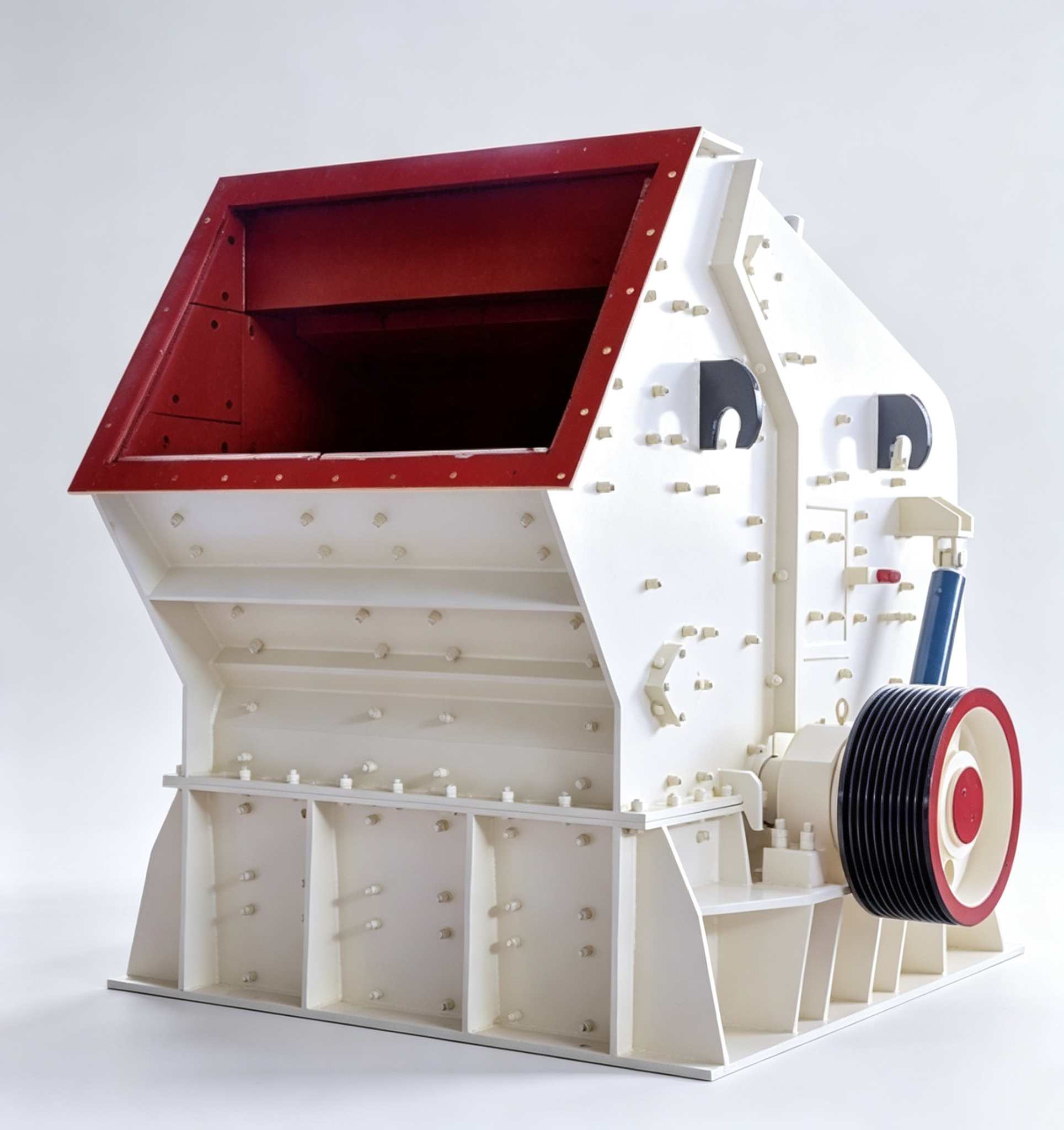
Impact Crusher uses high-speed blow bar impact + impact plate rebound (rock-on-anvil principle) for efficient crushing. Suitable for processing materials with side length not exceeding 500mm (PFV Series) / 1000mm (PF Series) and compressive strength not exceeding 350MPa, such as granite, limestone, concrete, etc. Large crushing ratio, excellent cubic particle shape, low flake content — ideal processing equipment for high-grade highway surfaces and hydropower station construction aggregates.
Impact Crusher uses high-speed rotating blow bars on the rotor to apply impact force, causing material to repeatedly collide and fracture between blow bars and impact plates. After material enters the crushing chamber, it is accelerated by high-speed rotating blow bars and thrown toward the impact plates, then rebounds back to the blow bar zone. This "blow bar impact — impact plate rebound — re-impact" cycle continuously fractures material along its natural joints and weak planes, providing selective crushing — softer components break first while harder components retain larger size. Final product has cubic particle shape with flake content far lower than jaw crusher, making it the preferred equipment for projects with strict aggregate shape requirements such as high-grade highway surfaces and hydropower dam construction.
After material enters the crushing chamber from the feed opening, the high-speed rotor (30-45 m/s tip speed) blow bars strike material with extremely high kinetic energy, accelerating it to near rotor tip speed and throwing it along the tangential direction.
Thrown material strikes the upper impact plate (first stage) and rebounds back to the rotor zone for another blow bar impact, then hits the second-stage impact plate and rebounds again. Material forms a "Z"-shaped repeated collision path between blow bars and the two-stage impact plates.
The gap between impact plates and blow bars determines final product size. Material fractures along natural joints and weak planes during repeated impact, discharging from the bottom opening when reaching target size. Impact plate gaps can be adjusted hydraulically or manually to control discharge size.
| Comparison Item | PF Series (Standard) | PFV Series (Fine Crushing) |
|---|---|---|
| Feed Opening Shape | Wide rectangular (820-1600mm wide) | Narrow tall rectangular (400-860mm wide) |
| Max Feed Size | 300-1000 mm | 300-500 mm |
| Capacity | 24-860 t/h | 25-180 t/h |
| Crushing Ratio | Medium (10-20) | Large (15-30) |
| Application | Primary/medium crushing, large material primary impact | Medium/fine crushing, finer and more uniform discharge |
| Typical Discharge Size | 15-60 mm | 5-30 mm |
| Model | FeedOpening Size (mm) | MaxFeed (mm) | 生Capacity力 (t/h) | Motor power (kW) | Weight (t) | Dimensions L×W×H (mm) |
|---|---|---|---|---|---|---|
| PF-1007 | 820×700 | 300 | 24-45 | 37-55 | 9.5 | 1800×1600×1800 |
| PF-1010 | 1170×720 | 350 | 50-80 | 55-75 | 10 | 2340×2007×2500 |
| PF-1210 | 1090×465 | 350 | 80-130 | 110-132 | 14 | 2582×2053×2809 |
| PF-1214 | 1440×465 | 350 | 100-160 | 132-160 | 18 | 2582×2403×2809 |
| PF-1315 | 1532×560 | 500 | 140-200 | 180-220 | 19.3 | 2930×2761×3053 |
| PF-1515 | 1580×696 | 500 | 220-280 | 250-280 | 28.5 | 3553×2835×3277 |
| PF-1620 | 1600×2080 | 800 | 350-450 | 500-560 | 47.5 | 3800×3350×3250 |
| PF-1822 | 1500×2250 | 1000 | 550-860 | 630 | 90 | 4260×3550×3640 |
※ PF Series suitable for primary and medium crushing, large feed opening and high capacity. Based on limestone (compressive strength ≤150MPa); capacity when crushing granite is approximately 60-80% of nominal value.
| Model | FeedOpening Size (mm) | MaxFeed (mm) | 生Capacity力 (t/h) | Motor power (kW) | Weight (t) | Dimensions L×W×H (mm) |
|---|---|---|---|---|---|---|
| PFV-1007 | 400×730 | 300 | 25-45 | 55 | 10.5 | 1800×1600×1800 |
| PFV-1010 | 400×1080 | 350 | 35-60 | 75 | 14.8 | 2340×2007×2500 |
| PFV-1210 | 400×1080 | 350 | 45-100 | 110 | 18 | 2582×2053×2809 |
| PFV-1214 | 400×1430 | 350 | 60-140 | 132 | 23.5 | 2582×2403×2809 |
| PFV-1315 | 860×1520 | 500 | 70-180 | 200 | 28 | 2930×2761×3053 |
※ PFV Series positioned for medium-fine crushing, narrower feed opening allows longer material retention in chamber for more thorough crushing and more uniform discharge shape. Technical data subject to change without notice.
| Component | Function | Material / Features |
|---|---|---|
| Rotor & Blow Bar | Core component of impact crusher, consisting of main shaft, rotor body and 4-6 blow bars. Rotor rotates at high speed (30-45 m/s tip speed), blow bars fixed to rotor body via wedges or bolts, impacting and crushing material. Large rotors dynamically balanced for smooth operation | 42CrMo shaft + high chromium cast iron blow bar |
| Impact Plate (Two-Stage) | First stage impact plate (upper) withstands the most intense material impact for primary crushing; second stage (lower) handles fine crushing and shaping. Both stage impact plate gaps independently adjustable to control discharge size. Impact plate surface cast with wear-resistant teeth | High manganese steel ZGMn13 / wear-resistant cast steel |
| Impact Plate Adjustment Device | Adjusts gap between impact plate and blow bar via hydraulic cylinder or screw mechanism for discharge size control and overload protection. Impact plate can retreat when encountering uncrushable material, protecting the main machine from damage | Hydraulic cylinder or spring screw |
| Crushing Chamber Shell | Upper and lower shell sections bolted together, with impact plate liners on inner wall. Shell uses integral casting or thick steel plate welded structure to withstand enormous impact loads. Feed opening at top, discharge opening at bottom | ZG270-500 cast steel / Q345B welded |
| Homogeneous Plate (Grinding Plate) | Arc-shaped liner in the discharge zone, providing final grinding and shaping to ensure cubic discharge particle shape with minimal flake particles | High chromium cast iron / wear-resistant alloy steel |
| Drive & Frame | Motor drives rotor via V-belts or hydraulic coupling. Frame is a rigid steel section welded base that withstands crushing impact forces. Large models equipped with hydraulic coupling for soft start, reducing grid impact | Y Series motor + hydraulic coupling (optional) |
Uses dual impact + rebound force for "selective crushing", single-stage crushing ratio up to 10-30 (jaw crusher only 4-6). Suitable for two-stage crushing replacing fine jaw + cone crusher combination, simplifying process and reducing equipment count.
Stone repeatedly collides between blow bars and impact plates, with flake particles preferentially breaking along weak planes. Finished product is cubic with flake content below 8% (jaw crusher typically 15-25%), meeting high-standard requirements for highway and hydropower station aggregates.
Impact plates equipped with spring or hydraulic overload protection devices. When uncrushable materials (bucket teeth, iron blocks, etc.) enter the crushing chamber, impact plates automatically retreat to allow passage, then auto-reset after the foreign object is discharged, protecting the rotor and blow bars from damage.
Blow bars use wedge-type locking structure, replaceable through the side maintenance door without disassembling the rotor. Impact plate liners are modular design with single-piece light weight, allowing individual replacement of worn areas for high maintenance efficiency and short downtime.
Discharge size can be steplessly adjusted within a certain range by hydraulically or manually adjusting the gap between two-stage impact plates and blow bars. PF Series typical discharge 15-60mm, PFV Series can reach 5-30mm, meeting various operating conditions.
Crushing work is directly applied to material without excess friction loss, with per-ton power consumption 20-30% lower than jaw crushers. Large PF-1822 achieves capacity of 550-860 t/h, making it the core secondary crushing equipment for large aggregate production lines.
Highway asphalt surface and concrete base have strict aggregate shape requirements (flakes ≤10%). Impact crusher discharge is cubic with rich edges and corners, good adhesion with asphalt — standard equipment for road surface aggregates.
Dam concrete requires high-strength, excellent-shape coarse aggregates. Impact crusher can process hard rock like granite and basalt, producing cubic aggregates that improve concrete density and compressive strength, meeting hydraulic specifications.
Replaces cone crusher in secondary or tertiary crushing stages, reducing 100-300mm material from jaw crusher to 15-40mm finished aggregate in one pass. Combined with sand maker, forms efficient "jaw + impact + sand maker" three-stage closed-circuit aggregate production line.
Impact crusher excels in construction waste processing: impact crushing effectively separates concrete from rebar, selective crushing strips old cement paste from aggregate surfaces, producing clean recycled aggregates. PF Series large feed opening can directly accept reinforced concrete blocks.
Need Impact Crusher? Contact us for crushing process solution and selection