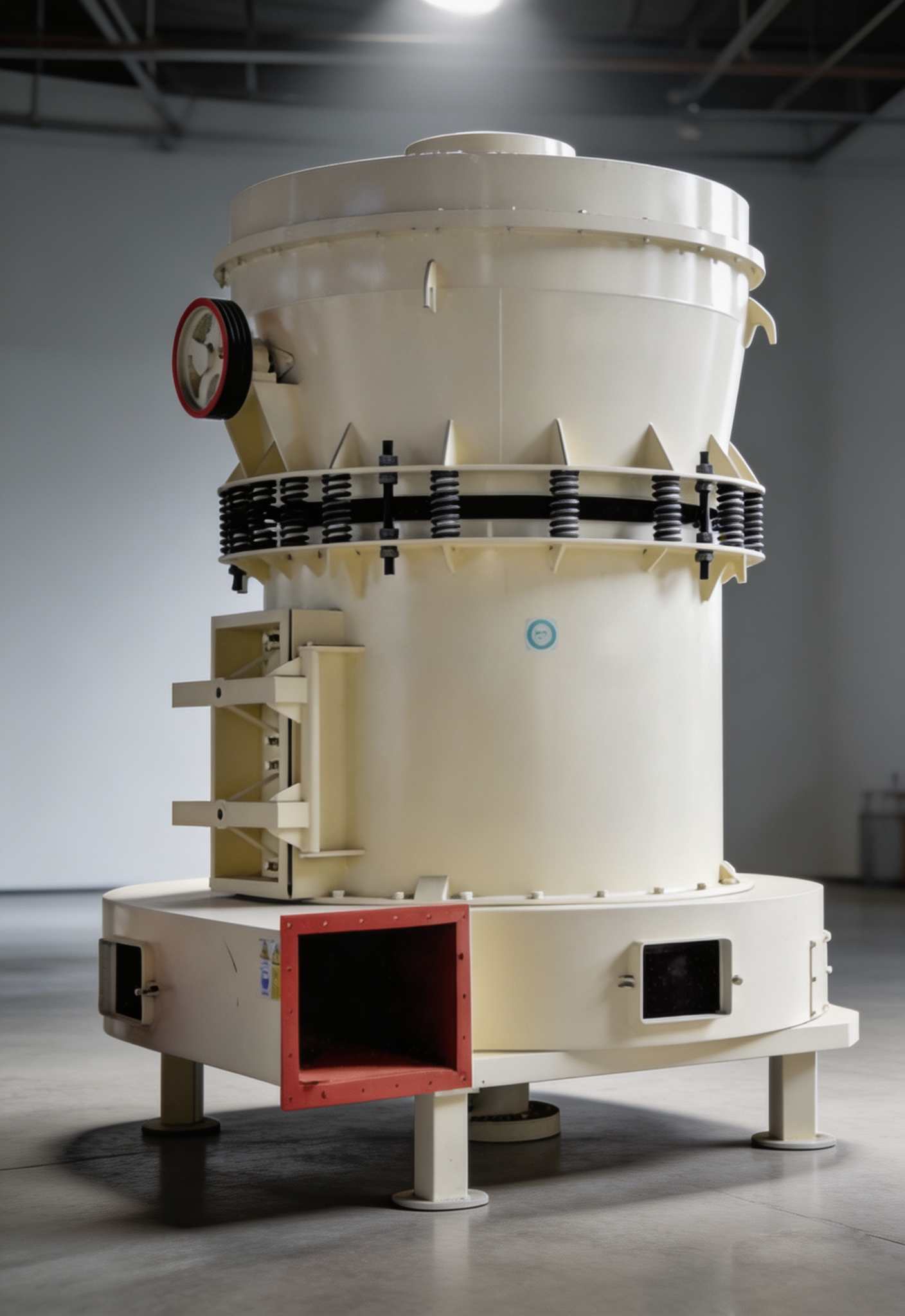
The Raymond Mill is a swing-type suspended roller grinding equipment with roller-ring grinding as its core principle. The full range includes 3R/4R/5R/6R traditional series and MTW European enhanced series. Feed size 15-50mm, product fineness 80-425 mesh (0.18-0.033mm), capacity 2-140 t/h. The whole system uses negative-pressure closed-circuit design — low dust, low noise, environmentally friendly and energy-saving.

The Raymond Mill is a swing-type suspended roller grinding equipment with roller-ring grinding as its core principle. Material is fed into the grinding chamber by a feeder, where grinding rollers press against the grinding ring under centrifugal force. The roller presses tightly against the grinding ring inner wall, rotating and grinding. Fine powder is carried by the fan airflow to the classifier for screening — qualified fines settle as product in the cyclone collector, while coarse particles return to the grinding chamber for further grinding. The full series covers 3R/4R/5R/6R traditional series and MTW European enhanced series, feed size 15-50mm, product fineness 80-425 mesh (0.18-0.033mm), capacity 2-140 t/h. Suitable for grinding various non-metal and metal ores with Mohs hardness 7-8 and moisture below 6%, widely used in metallurgy, building materials, chemicals, mining, ceramics, refractories and other industries. The whole system uses negative-pressure closed-circuit design — low dust, low noise, environmentally friendly and energy-saving.
The motor drives the main shaft through a reducer. The spider frame at the top of the main shaft drives 3-6 grinding roller assemblies in revolution around the center. Under centrifugal force, the grinding roller presses tightly against the grinding ring inner wall — material is repeatedly crushed and ground between the roller and ring into fine powder. The grinding roller has no independent drive, relying entirely on friction for rotation — simple and reliable structure.
Ground powder is lifted by high-speed airflow from the blower fan, carried through the pipeline to the high-efficiency classifier above. The classifier impeller rotates at a set speed — adjusting the speed precisely controls product fineness (higher speed = finer particles). Qualified fines pass through the impeller to the cyclone collector, while coarse powder falls back to the grinding chamber through the return pipe for further grinding.
Qualified fine powder settles by centrifugal force in the cyclone collector and is discharged from the bottom discharge valve as finished product. Dust-laden exhaust gas passes through a pulse bag filter for purification before being discharged to the atmosphere (or partially recirculated). The entire system operates under negative pressure — no dust leakage.
| Model | Feed Size (mm) | Product Fineness (mesh) | Capacity (t/h) | Roller Dia. (mm) | Rollers | Main Motor (kW) | Fan Motor (kW) |
|---|---|---|---|---|---|---|---|
| 3R2615 | 15-20 | 80-425 | 2-2.4 | 260 | 3 | 18.5 | 18.5 |
| 3R3016 | 20-25 | 80-425 | 3-3.4 | 300 | 3 | 30 | 22 |
| 4R3216 | 20-25 | 80-425 | 3-3.9 | 320 | 4 | 37 | 30 |
| 5R4119 | 20-30 | 80-425 | 5-5.5 | 410 | 5 | 90 | 75 |
| 5R4121 | 20-30 | 80-425 | 5-6.6 | 410 | 5 | 90 | 75 |
| 6R4427 | 20-50 | 80-425 | 10-14 | 440 | 6 | 132 | 132 |
| MTW110 | ≤20 | 80-425 | 3.5-10 | 310 | 4 | 55 | 55 |
| MTW175 | ≤30 | 80-425 | 10-22 | 460 | 4 | 160 | 160 |
| MTW215 | ≤50 | 80-425 | 22-50 | 600 | 4 | 280 | 310 |
※ Capacity based on limestone (Mohs 3-4, moisture ≤3%) at 200 mesh fineness. Actual output varies with material hardness, moisture and target fineness. Specifications subject to change without notice.
| Component | Function | Material / Spec |
|---|---|---|
| Main Unit (Grinding Chamber) | Houses the grinding roller and ring, providing an enclosed grinding space. Welded steel plate structure with wear-resistant lining, slag discharge port at bottom for difficult-to-grind impurities | Q235 steel welded housing + wear liner |
| Grinding Roller | Core grinding component, cantilever-mounted on spider frame. Roller revolves with frame and rotates by friction with material, providing both compression and grinding action | High-chromium cast iron / ZG65Mn, HRC 55-60 |
| Grinding Ring | Pairs with grinding roller to form the grinding pair, fixed to the inner wall of the main unit housing. The ring inner surface is tapered — material is progressively crushed and ground as it moves downward through the tapered gap | 65Mn high-manganese steel casting |
| Spider Frame (Star Frame) | Connects main shaft to grinding roller assemblies, transmitting rotary motion from the main shaft to drive roller revolution. The spider frame bears all centrifugal loads from rollers — requires high-strength steel casting | ZG35 cast steel |
| Classifier (Separator) | Vane-type centrifugal classification rotor mounted above the main unit. Adjusting impeller speed controls product fineness — higher speed = finer particles. Coarse powder falls back to grinding chamber via return pipe; qualified fines enter cyclone collector | Vane-type centrifugal rotor |
| Cyclone Collector | Centrifugally separates gas-solid flow. Powder-laden air enters tangentially — powder settles at the bottom and is discharged through the discharge valve; clean gas exits from the top. Multiple cyclones in parallel for higher collection efficiency | Q235 steel welded |
| Blower Fan | High-pressure centrifugal fan providing airflow circulation for the entire system. The fan blows external air into the main unit, carrying ground powder to the classification and collection system. Air volume and pressure matched to the grinding chamber design | High-pressure centrifugal fan |
| Pulse Dust Collector | Bag filter with pulse jet cleaning, purifies exhaust gas from the cyclone collector outlet. Emission concentration ≤30mg/m³, meeting environmental standards. Bag material: polyester needle felt or PPS high-temperature material | Bag filter + pulse jet |
| Feeder | Uniform metered feeding to prevent main unit clogging. Electromagnetic vibrating feeder or screw feeder based on material properties and capacity requirements; feed rate is steplessly adjustable | Electromagnetic vibratory/screw feeder |
Classifier impeller speed is adjustable, product fineness covers the full 80-425 mesh range for different industry standards. From 80-120 mesh coarse powder for construction to 325-425 mesh ultrafine powder for chemicals — all switchable via VFD without stopping to change parts.
Can process over 200 types of non-metal and metal ores with Mohs hardness ≤8 and moisture ≤6%. Including calcite, limestone, kaolin, barite, talc, bentonite, quartz, feldspar, dolomite, gypsum and various industrial minerals — one of the most widely used dry grinding machines.
Main unit + classifier + pipeline + cyclone collector integrated in a vertical layout — small footprint, ideal for indoor installation. Compared to ball mills of the same capacity, floor space is reduced by 50-70% with significantly lower civil engineering costs. Modular design for short installation — 3R/4R small models can be hoisted as a complete unit.
The entire system operates under negative pressure with closed air circulation — minimal dust leakage, low noise, meeting environmental requirements. Pulse bag filter emission ≤30mg/m³, superior to national standards. Partial air recirculation available for further energy savings.
Grinding roller and ring made of high-chromium cast iron / 65Mn high-manganese steel, HRC 55-60. Normal service life 1-2 years under standard conditions. Roller and ring can be flipped (top-bottom symmetrical) for higher utilization. Quick replacement — one shift sufficient for full change.
MTW series features bevel gear integral transmission, curved scrapers, isolated cyclone collection and other European technologies — significantly improved capacity and fineness. MTW215 single machine capacity up to 50 t/h, equivalent to 3-4 times the traditional 6R model. Smooth transmission, low noise, minimal maintenance — ideal for export projects and high-standard lines.
Calcite (calcium carbonate) is one of the largest application areas of Raymond mills, producing heavy calcium carbonate powder. Finished fineness 200-400 mesh, widely used as filler in plastics, rubber, coatings and paper. Capacity configuration: 3R2615 approx. 2 t/h, 5R4119 approx. 5 t/h, MTW175 approx. 15 t/h.
Power plant FGD requires large quantities of 250-325 mesh limestone powder as desulfurization agent. Raymond mills are the main equipment for power plant FGD powder grinding — MTW series especially suitable for large power plant FGD stations (single unit 20-50 t/h), stable fineness, long-term continuous operation.
Kaolin ground to 200-325 mesh by Raymond mill for ceramics, paper, rubber and other industries. Kaolin has low abrasiveness — roller and ring life can exceed 2 years. High whiteness product, no iron contamination (optional ceramic or rubber lining in main unit).
Barite (barium sulfate) has high density (4.2-4.5 g/cm³) and is the main weighting agent for oil drilling mud. Product fineness 200-325 mesh. 5R/6R series are main models for barite grinding. Barite has low abrasiveness but high density — capacity must be calculated based on actual material.
Talc has low hardness (Mohs 1), making it one of the easiest materials for Raymond mills. 325-425 mesh talc powder used in cosmetics, pharmaceuticals, plastic modification. Talc is light with good flowability — cyclone collection efficiency needs attention, recommend high-efficiency cyclone cluster.
Bentonite (montmorillonite) ground to 200 mesh for foundry, drilling mud, metallurgical pellets. Bentonite is highly absorbent — moisture control is critical: must be dried to ≤6% before grinding. MTW series curved scrapers perform better than traditional flat scrapers for bentonite conveying.
Need a Raymond Mill? Contact us for selection and quote