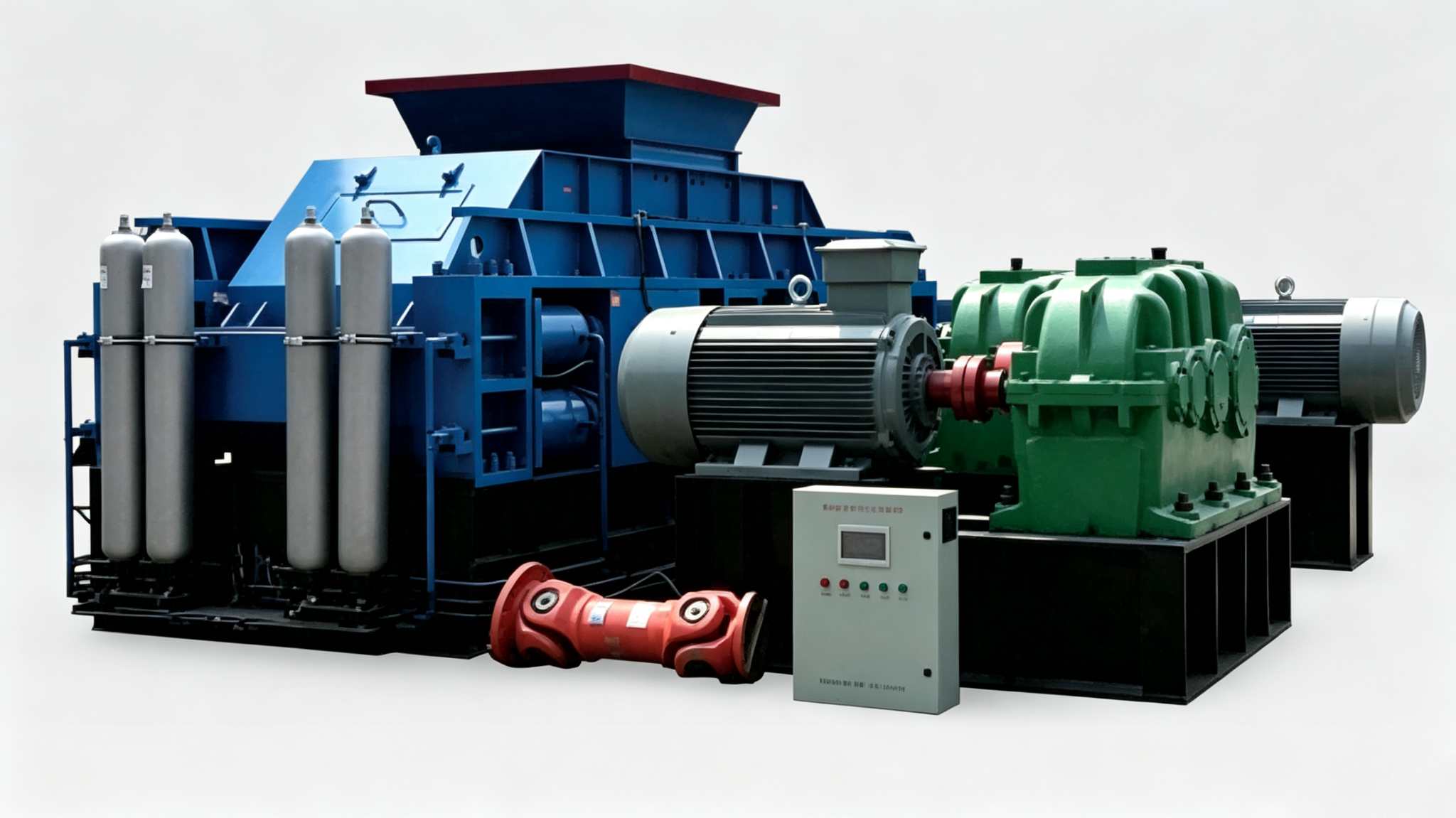
Counter Roll Crusher

2PG Series · Feed ≤130mm · 2–120 t/h

Roll Crusher (Double Roll Crusher) uses two counter-rotating rollers to apply compression and shear forces to crush materials. Reliable operation, simple maintenance, low operating cost, adjustable discharge size. Widely used in cement, metallurgy, chemical, power, coal industries, with good adaptability to both brittle and tough materials.

Roll Crusher

Product OverviewProduct Overview

The Roll Crusher (Counter Roll Crusher, also known as Double Roll Crusher) is a traditional crushing equipment that uses the compression force generated by two cylindrical rollers rotating towards each other to crush materials. Material falls between the two rollers from the feed opening, is crushed by compression, shear, and grinding actions of the roller surfaces to the required particle size, and then discharged from below. The roller gap can be precisely controlled through adjustment devices, allowing flexible adjustment of discharge size (2-10mm). The Roll Crusher features simple and compact structure, stable and reliable operation, minimal over-crushing, and extremely low maintenance costs, making it an economical choice for medium and small-scale fine crushing of brittle materials (limestone, clinker, coal, coke, etc.). According to the number of rollers, it can be divided into double-roll (2PG) and four-roll (4PG) types, with double-roll crushers being the most widely used.

Working PrincipleWorking Principle

1

Material enters roller gap

Material is evenly fed between two counter-rotating rollers through the feeding device. The friction on the roller surfaces pulls the material into the compression zone (nip) between the two rollers. Feed size is limited by roller diameter and nip gap; the maximum feed size should be less than 3-4 times the nip gap to ensure smooth gripping.

2

Compression and shear crushing

Material at the narrowest point of the nip is subjected to enormous radial compressive force (up to hundreds of MPa), while simultaneously undergoing shear due to speed difference between the rollers or friction difference on roller surfaces. Brittle materials are crushed by compression, while tough materials are torn apart. The compression crushing process mainly occurs along mineral grain boundaries and joint planes.

3

Gap control and discharge

Spring or hydraulic devices maintain the set gap between the two rollers. Material is crushed to a size smaller than this gap and discharged from the bottom by gravity. The roller gap can be steplessly adjusted via shims or screws (2-10mm) to achieve different discharge sizes. When encountering uncrushable objects, the movable roller retreats under spring action to protect the equipment from damage.

Roller Compression Crushing Path
Material fed Roller friction pulls into nip Radial compression + shear crushing Gravity discharge at required size

2PG SeriesTechnical Parameters2PG Series Parameters

ModelFeed Size (mm)Discharge Size (mm)Capacity (t/h)Motor Power (kW)Dimensions L×W×H (mm)
2PG400×250<352-82-102×5.52150×980×816
2PG400×400<352-95-122×7.52700×1400×1200
2PG610×400<652-105-202×153510×1400×1030
2PG750×500<752-1010-402×18.54220×1600×1205
2PG800×600<802-1012-452×224550×1800×1350
2PG1000×800<1002-1020-652×555310×2190×1565
2PG1200×800<1202-1035-802×906250×2280×1865
2PG1500×800<1303-1050-1202×1327460×2480×2265

※ Based on limestone (compressive strength ≤120MPa), discharge size 2-10mm. Capacity varies depending on material, feed size, and other factors. Technical data subject to change without notice.

Structure ComponentsStructure Components

ComponentFunctionMaterial / Features
Rollers (Fixed + Movable)Two cylindrical rollers mounted horizontally in parallel, one fixed on the frame, the other mounted on a sliding bearing base that can move along rails. The two rollers rotate towards each other, applying compression and shear forces to the material.High manganese steel ZGMn13 roller sleeve / Integral casting
Roller Shell (Wear-resistant Liner)Replaceable wear-resistant sleeve installed on the roller outer circumference, bearing direct wear. Can be removed and replaced when worn, without replacing the entire roller body. Smooth surface for fine crushing, toothed surface for coarse crushing.High chromium cast iron / Mn13 wear-resistant steel
Roller Gap Adjustment DeviceAdjusts the limit position of the movable roller by adding/removing shims or rotating screws, thereby setting the minimum gap between the two rollers (discharge size). Spring pressure ensures the two rollers maintain the set gap during operation.Shim type or Screw type
Spring Overload ProtectionPowerful compression springs installed behind the movable roller bearing base. When uncrushable material enters, the movable roller overcomes spring force and retreats. After the foreign object is discharged, the spring automatically resets. Spring preload is adjustable to match different material hardness.60Si2Mn Spring Steel
Drive Transmission SystemTwo electric motors drive the fixed and movable rollers respectively through V-belts or couplings. The two rollers are independently driven, with slight speed differences to enhance shear effect. Large specification models are equipped with hydraulic couplers for soft start on one side.Y Series Motor + V-belt
Frame and Feed HopperRigid welded steel frame bearing all crushing forces and equipment self-weight. Feed hopper at the top directs material to the center between the two rollers. Open discharge opening at the bottom.Q345B Steel Welding

Product FeaturesProduct Features

Simple structure, reliable operation

The whole machine consists of only four parts: rollers, bearing bases, spring adjustment, and drive — no complex transmission mechanisms. Few failure points, high continuous operation rate, suitable for long-term unattended operation in remote mines.

Precise adjustable discharge size

Stepless adjustment of the two-roller gap (2-10mm) via shims or screws ensures stable and controllable discharge size. Unlike impact crushers, the roll crusher's discharge size does not change with hammer wear and remains consistent.

Low over-crushing, low fines generation

The compression crushing principle causes material to break mainly along weak planes, resulting in far lower powder content than hammer crushers and impact crushers. Higher yield for applications requiring specific particle size ranges (e.g., 3-8mm).

Low operating cost

Low dual motor power (min 2×5.5kW), very low power consumption per ton. Roller shells can be rebuilt by welding or replaced when worn. Simple maintenance, low parts cost. No high-speed rotating parts, minimal lubricating oil consumption.

Suitable for brittle and tough materials

Not only suitable for brittle materials like limestone, clinker, coke, but also effective for materials containing tough components such as coal, clay, and shale. The roller surface friction feed method is not limited by material hardness uniformity.

Compact size, small footprint

Compared to jaw or hammer crushers of the same capacity, the roll crusher has a compact footprint (min. only 2.1m long). Ideal for space-constrained workshop retrofit projects or as a secondary fine crushing module in mobile crushing stations.

Application FieldsApplication Fields

Cement clinker and raw material fine crushing

In cement production, the roll crusher finely crushes limestone and clinker from 30-60mm to 2-5mm, significantly reducing the feed size for subsequent ball mills. Achieves "more crushing, less grinding" energy savings, reducing ball mill system power consumption by 15-25%.

Coal and coke crushing

Coal mines and coking plants use roll crushers to crush raw coal or coke to a uniform 3-10mm size, meeting the feed size requirements for coal chemical gasifiers and coke ovens. Low over-crushing, low fines rate, significant economic benefits.

Metallurgical and chemical raw material processing

Used for fine crushing of sinter and ferroalloys in the metallurgical industry, and particle size control of brittle minerals like phosphate rock and potassium salts in the chemical industry. Stable discharge size meets strict particle size requirements for subsequent reaction processes.

Brick & Ceramic Raw Material Preparation

The roll crusher is used in the brick and ceramic industries for fine crushing of shale, clay, feldspar and other raw materials, crushing large material to 2-5mm before ball mill grinding. The smooth roller surface resists material adhesion, making it suitable for processing high-moisture clay materials.

Cement ClinkerCoal & CokeSinterLimestoneChemical Raw MaterialsBrick ShaleFerroalloyPotassium Salt

Selection AdviceSelection Advice

  1. Match Model by Max Feed Size:Feed size is proportional to roller diameter — the roll crusher's gripable feed size is about 1/10-1/20 of roller diameter. Feed ≤35mm: 2PG400; ≤80mm: 2PG800; ≤130mm: 2PG1500. Not recommended to exceed the rating, otherwise material cannot be gripped by roller surface friction.
  2. Discharge Size Determines Roller Gap:2PG full series discharge range 2-10mm, achieved by adjusting roller gap. For applications requiring stable narrow particle size distribution (e.g., 2-4mm), the roll crusher has advantages over hammer crushers. If discharge >10mm is needed, consider jaw or impact crushers instead.
  3. Capacity Adjusted by Material Hardness:Table capacity is based on limestone. When crushing hard materials (granite, quartzite), capacity is about 50%-70% of rated value with accelerated roller shell wear. For highly abrasive materials, recommend selecting a larger model to balance wear rate and capacity.
  4. Select Roller Shell Material by Material:For medium-soft brittle materials (limestone, clinker, coal): high chromium cast iron roller shell recommended, good value. For hard rock and highly abrasive materials: high manganese steel (Mn13) roller shell with work-hardening characteristic — surface gets harder with wear. Roller shells are consumables, recommend one spare set.

Need Roll Crusher? Contact us for selection configuration and quote